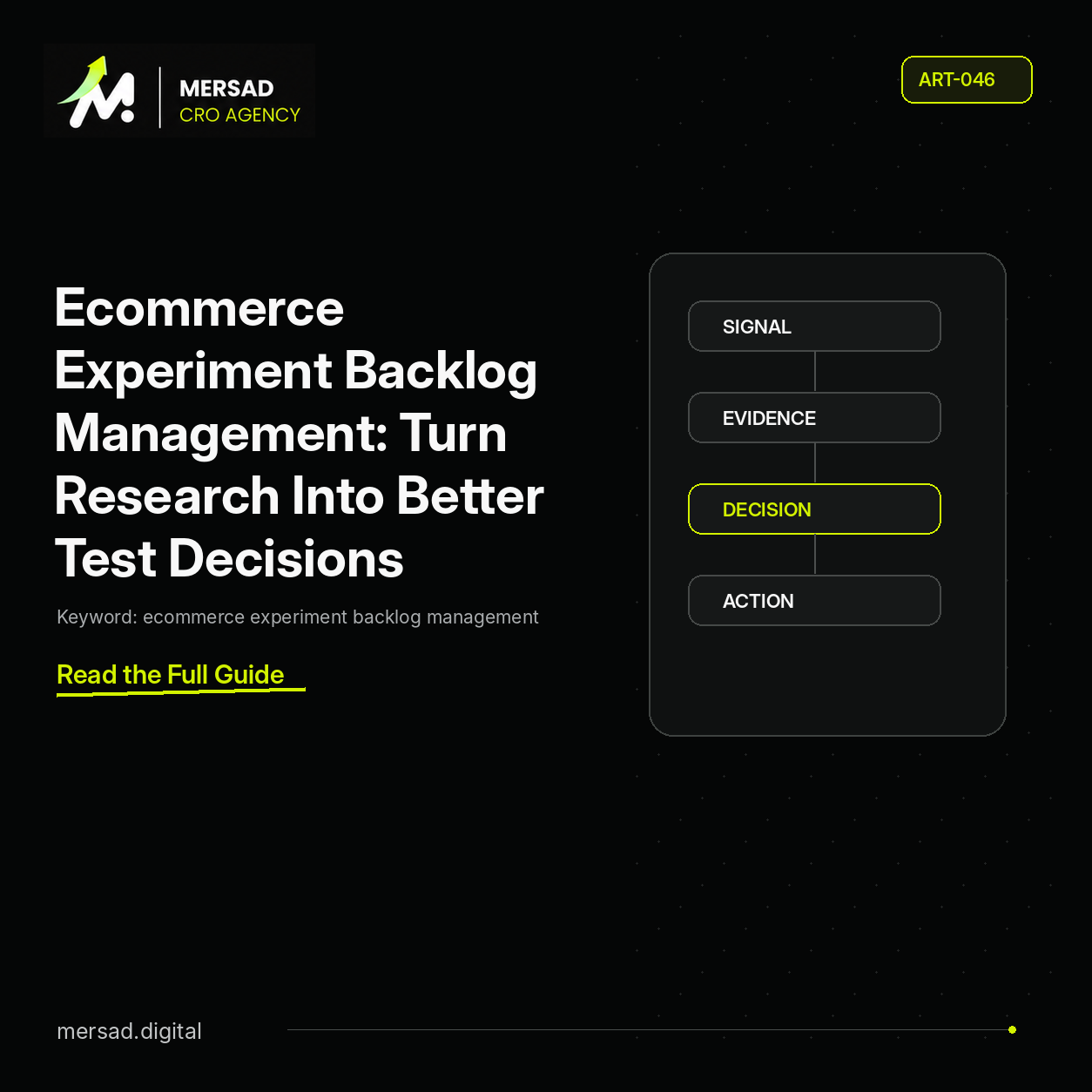
Ecommerce Experiment Backlog Management: Turn Research Into Better Test Decisions
Ecommerce experiment backlog management is useful when it helps an ecommerce team make a clearer commercial decision. Experiment backlogs become warehouses of ideas when observations, hypotheses, research, sample feasibility, and business priorities are not connected.
The right approach is to connect eligible exposure, evidence strength, primary metric opportunity, sample feasibility, implementation effort, and strategic value and then break the result down by problem area, funnel stage, audience, research source, technical dependency, and test feasibility. This guide focuses on diagnosis, operational feasibility, and measurable business impact rather than generic CRO tactics.
The objective is not to create another checklist. It is to understand the mechanism behind the problem, define what evidence is missing, and choose whether the next action should be a direct fix, deeper research, implementation, or an experiment. In the context of ecommerce experiment backlog management, keep this evidence scoped to experiment backlog rather than applying it as a universal ecommerce rule.
Store problems, not just test ideas
A useful backlog starts with the observed customer or business problem. ‘Test a sticky CTA’ is an idea. ‘Mobile shoppers lose the CTA during a long PDP and recordings show repeated scroll-back behavior’ is a problem with evidence.
Attach evidence to every backlog item
Link analytics, recordings, survey findings, support themes, search logs, or previous experiments. An idea without evidence can remain in an inspiration list but should not compete equally with validated opportunities.
For ecommerce experiment backlog management, document the affected audience, evidence source, business exposure, owner, and success metric so the recommendation stays tied to a decision rather than becoming a generic site-wide change.
Define the decision the test would change
Before prioritizing, state what the business will do for a win, loss, or inconclusive result. If the team plans to ship regardless, experimentation may not be the right tool.
Add sample feasibility before design starts
Estimate eligible users, baseline rate, and commercially meaningful MDE early. A high-impact idea that needs six months of traffic may not belong in the near-term test roadmap.
Separate direct fixes from experiments
Broken tracking, payment failures, inaccessible controls, and objectively incorrect content should bypass the experiment backlog and move into the fix queue.
For ecommerce experiment backlog management, document the affected audience, evidence source, business exposure, owner, and success metric so the recommendation stays tied to a decision rather than becoming a generic site-wide change.
Score evidence, exposure, impact, effort, and risk
Use a consistent model such as Impact × Confidence ÷ Effort, but add exposure and sample feasibility where appropriate. The score should support judgment, not replace it.
Manage dependencies explicitly
Flag tests that depend on a component release, analytics event, product availability, legal approval, or platform capability. Dependencies often explain why high-priority ideas cannot run immediately.
Review and prune the backlog regularly
Remove duplicate ideas, outdated hypotheses, tests made irrelevant by product changes, and items with no remaining evidence. A smaller decision-ready backlog is more valuable than hundreds of entries.
For ecommerce experiment backlog management, document the affected audience, evidence source, business exposure, owner, and success metric so the recommendation stays tied to a decision rather than becoming a generic site-wide change.
A practical diagnostic worksheet
For ecommerce experiment backlog management, use a compact worksheet rather than a long unprioritized audit.
| Field | What to record |
|—|—|
| Business outcome | Revenue, orders, conversion efficiency, or operational impact |
| Exposed audience | The users, products, pages, or regions actually affected |
| Current signal | The measured rate, behavior, error, or customer feedback |
| Comparison | Historical period, internal segment, or control |
| Evidence quality | Analytics, technical proof, qualitative research, or mixed |
| Hypothesis | The explanation that still needs validation |
| Action type | Fix, research, implement, experiment, or monitor |
| Owner | Team accountable for the next step |
| Success metric | The metric expected to move if the action works |
| Guardrail | A business or customer outcome that must not deteriorate | In the context of ecommerce experiment backlog management, keep this evidence scoped to experiment backlog rather than applying it as a universal ecommerce rule.
This structure makes assumptions visible. It also prevents teams from treating a correlation as a proven cause.
Measurement framework
A useful this topic report should separate three layers.
Commercial outcome
Use the business metrics most relevant to the decision: eligible exposure, evidence strength, primary metric opportunity, sample feasibility, implementation effort, and strategic value.
Diagnostic segmentation
Break the result down by problem area, funnel stage, audience, research source, technical dependency, and test feasibility.
Evidence and guardrails
Add customer-behavior evidence, technical integrity checks, and downstream guardrails that could reveal a harmful tradeoff. In the context of this topic, keep this evidence scoped to experiment backlog rather than applying it as a universal ecommerce rule.
Do not manufacture an external benchmark simply because the report needs a target. Internal history, comparable segments, and the economics of the store are often more decision-relevant. In the context of this topic, keep this evidence scoped to experiment backlog rather than applying it as a universal ecommerce rule.
What data should be collected before the first recommendation?
A serious this topic review should start by defining the minimum evidence needed to make the decision. The exact dataset depends on the business question, but the team should normally collect the commercial outcome, the audience exposed to the issue, the relevant page or operational stage, and the time period in which the change occurred. For experiment backlog, the evidence set should also include the business and operational context specific to this topic.
Useful quantitative inputs can include sessions, users, orders, revenue, conversion rate, revenue per session, AOV, product exposure, add-to-cart behavior, checkout progression, error events, payment outcomes, stock status, and delivery conditions. Not every metric belongs in every analysis. The goal is to use the smallest set that can isolate the mechanism. In the context of this topic, keep this evidence scoped to experiment backlog rather than applying it as a universal ecommerce rule.
Qualitative inputs should also be selected intentionally. Session recordings, user testing, support conversations, reviews, on-site surveys, and search logs are most valuable when they answer a question already identified in the data. Watching random recordings without a defined cohort can generate anecdotes rather than evidence. In the context of this topic, keep this evidence scoped to experiment backlog rather than applying it as a universal ecommerce rule.
Finally, create a change log. Record releases, campaign launches, promotions, pricing updates, stock incidents, payment changes, delivery changes, and tracking deployments. This timeline helps prevent the team from assigning a website cause to a business or operational change. In the context of this topic, keep this evidence scoped to experiment backlog rather than applying it as a universal ecommerce rule.
How to establish a useful comparison
The comparison should match the decision. For this analysis, useful comparisons can include:
- The same segment in a previous stable period.
- A comparable period with similar campaign and promotion conditions.
- Mobile versus desktop when the interaction model differs.
- New versus returning customers.
- One product/category against a similar internal category.
- One region against another only when sample and operational conditions are understood.
- Topic-specific check: connect this list to this topic and the actual exposed audience before prioritizing.
- ART-046 focus: apply this to experiment backlog and the specific customer or operational condition being analyzed.
Avoid choosing the comparison after seeing which one creates the most dramatic story. Define it from the business context. In the context of this topic, keep this evidence scoped to experiment backlog rather than applying it as a universal ecommerce rule.
Absolute and relative changes should be reported together. A move from 2.0% to 2.2% is +0.2 percentage points and +10% relative. Both are correct, but they communicate different scale. Reporting only the larger-looking number can mislead stakeholders. In the context of this topic, keep this evidence scoped to experiment backlog rather than applying it as a universal ecommerce rule.
How to size business impact conservatively
Commercial sizing is useful when it clarifies priority, not when it turns a hypothesis into a revenue promise.
A simple diagnostic can compare current outcomes with outcomes at a defensible internal comparison rate:
Expected outcomes = Current eligible volume × Comparison progression rate
Then:
Diagnostic gap = Expected outcomes − Actual outcomes
If the analysis concerns orders, a revenue range can be created using the relevant AOV. If product economics vary, use category-specific value or contribution margin where available. In the context of this topic, keep this evidence scoped to experiment backlog rather than applying it as a universal ecommerce rule.
This calculation should be labelled as an estimate. It assumes the comparison rate is relevant and does not prove that a proposed UX change will recover the gap. The purpose is to determine whether the issue deserves deeper investigation relative to other opportunities. In the context of this topic, keep this evidence scoped to experiment backlog rather than applying it as a universal ecommerce rule.
How to combine quantitative and qualitative evidence
Different evidence types answer different questions.
Analytics
Shows where performance changed and which segments contributed.
Technical validation
Shows whether tracking, rendering, payment, or platform behavior is objectively broken.
Behavioral observation
Shows what customers attempt, repeat, ignore, or struggle to complete.
Voice of customer
Shows the language customers use and the concerns they express.
Operational data
Shows whether stock, shipping, payment acceptance, fulfillment, or policy conditions can explain the result. In the context of this topic, keep this evidence scoped to experiment backlog rather than applying it as a universal ecommerce rule.
For this analysis, confidence becomes stronger when multiple independent evidence sources point toward the same mechanism. A single heatmap or one customer comment should not outweigh a contradictory commercial pattern. In the context of this topic, keep this evidence scoped to experiment backlog rather than applying it as a universal ecommerce rule.
Build a decision tree instead of a recommendation dump
A decision tree is more useful than a list of 50 tactics.
Start with the measured problem.
If measurement is unreliable: fix tracking first.
If the change is driven by traffic mix: work with acquisition and landing allocation.
If the change starts in product discovery: investigate navigation, search, filters, merchandising, and product-card relevance. In the context of this topic, keep this evidence scoped to experiment backlog rather than applying it as a universal ecommerce rule.
If the change starts on the PDP: investigate product fit, price, images, variants, delivery, returns, reviews, and CTA behavior. In the context of this topic, keep this evidence scoped to experiment backlog rather than applying it as a universal ecommerce rule.
If the change starts in checkout: investigate form, shipping, payment, technical, and operational friction.
If the cause remains uncertain: collect focused research or design an experiment when sample allows.
This structure keeps experiment backlog and CRO test backlog connected to the business diagnosis rather than becoming isolated optimization tactics.
Stakeholder ownership
A this analysis initiative often crosses multiple teams. Clear ownership prevents findings from becoming permanent backlog items. In the context of this topic, keep this evidence scoped to experiment backlog rather than applying it as a universal ecommerce rule.
| Problem type | Typical owner |
|—|—|
| Tracking / event integrity | Analytics + Development |
| Traffic quality / campaign routing | Media / Growth |
| Product data / merchandising | Ecommerce / Merchandising |
| UX / content hierarchy | CRO + UX |
| Front-end implementation | Development |
| Payment / shipping / fulfillment | Operations / Finance / Development |
| Experiment design | CRO + Analytics |
| Customer feedback themes | CX / Support | In the context of this topic, keep this evidence scoped to experiment backlog rather than applying it as a universal ecommerce rule.
The exact organization may differ. What matters is that every priority has one accountable owner and clear dependencies.
How to QA the implementation
After a change connected to this analysis is shipped, validate both function and measurement.
Check:
- The intended user segment receives the correct experience.
- Mobile and desktop states work.
- Key browsers behave correctly.
- Product, variant, price, and stock states are handled.
- Cart and checkout are not unintentionally affected.
- Analytics events still fire with the correct definitions.
- Internal links and CTAs resolve to live destinations.
- Performance does not deteriorate materially.
- Operational teams understand any new promise or workflow.
- Rollback is possible for high-risk changes.
- Topic-specific check: connect this list to this topic and the actual exposed audience before prioritizing.
- ART-046 focus: apply this to experiment backlog and the specific customer or operational condition being analyzed.
QA is part of CRO. A theoretically strong recommendation can become a conversion problem when implementation creates a new defect. In the context of this topic, keep this evidence scoped to experiment backlog rather than applying it as a universal ecommerce rule.
How to monitor after launch
Monitoring should use the same segment and metric definitions that justified the change.
Avoid declaring success from a sitewide conversion movement if the intervention affects only one category or one campaign. Compare the exposed journey and check guardrails. In the context of this topic, keep this evidence scoped to experiment backlog rather than applying it as a universal ecommerce rule.
If the change was not tested experimentally, report the result as an observed post-launch movement with limitations. Other factors may have changed at the same time. In the context of this topic, keep this evidence scoped to experiment backlog rather than applying it as a universal ecommerce rule.
For this experiment backlog topic, useful monitoring can include the primary progression metric, revenue per session, AOV, error rate, customer support themes, and any relevant downstream cost.
When experimentation is appropriate
A/B testing is useful when:
- Multiple valid solutions exist.
- The customer response is uncertain.
- The affected audience is large enough.
- Tracking is reliable.
- The proposed change has meaningful business exposure.
- Guardrails can be monitored.
- Topic-specific check: connect this list to this topic and the actual exposed audience before prioritizing.
- ART-046 focus: apply this to experiment backlog and the specific customer or operational condition being analyzed.
Do not test whether a broken link, invalid event, failed payment flow, inaccessible control, or incorrect product state should remain broken. Fix it. In the context of this topic, keep this evidence scoped to experiment backlog rather than applying it as a universal ecommerce rule.
For this analysis, experimentation should answer a decision that the team genuinely intends to change based on the result. In the context of this topic, keep this evidence scoped to experiment backlog rather than applying it as a universal ecommerce rule.
How this becomes a repeatable operating process
A repeatable process prevents the team from starting from zero every month.
Weekly: monitor the core signal and major incidents.
Monthly: review the highest-value segment, customer evidence, and implementation backlog.
Quarterly: reassess the measurement model, research themes, operational constraints, and strategic priorities.
Maintain a decision log with the original evidence, action, owner, deployment date, result, and learning. This is especially valuable for experimentation roadmap, where the same issue can reappear in different parts of the customer journey.
Final decision criteria
Before closing a this analysis task, the team should be able to answer:
- What problem was observed?
- Which segment was affected?
- What data supports it?
- What alternative explanations were ruled out?
- What action was taken?
- Why was that action chosen?
- What metric and guardrail were monitored?
- What was learned?
- What should happen next?
- Topic-specific check: connect this list to this topic and the actual exposed audience before prioritizing.
- ART-046 focus: apply this to experiment backlog and the specific customer or operational condition being analyzed.
If those questions cannot be answered, the work may have produced activity without producing a reliable CRO decision.
Failure modes to avoid
- Prioritizing the easiest test.
- Copying competitor experiments as evidence.
- Ignoring sample feasibility.
- Keeping bugs in the test backlog.
- Measuring backlog size instead of decision quality.
From analysis to execution
Every recommendation from a this experiment-backlog process review should contain:
- Issue: what is happening.
- Evidence: what supports the diagnosis.
- Impact: how much commercially relevant exposure exists.
- Recommendation: the next action.
- Why it may work: the user or business mechanism.
- Priority: Critical, High, Medium, or Low.
- Effort: design, development, analytics, operations, or content effort.
- Owner: who is accountable.
- Required validation: what remains uncertain.
- Success metric: what will indicate improvement.
- Topic-specific check: connect this list to this topic and the actual exposed audience before prioritizing.
- ART-046 focus: apply this to experiment backlog and the specific customer or operational condition being analyzed.
Obvious bugs, tracking failures, broken links, incorrect pricing, or payment defects should be fixed directly. A/B testing is appropriate when customer response is genuinely uncertain and the sample is feasible. In the context of this topic, keep this evidence scoped to experiment backlog rather than applying it as a universal ecommerce rule.
FAQ
What is this experiment-backlog process?
It is a structured way to analyze experiment backlog using ecommerce data, user behavior, operational context, and business impact so the team can choose the right next action.
Which data should I start with?
Start with the business outcome, the relevant funnel or operational signal, and the segment exposed to the issue. Add qualitative or technical evidence only where it helps explain the measured problem. In the context of this topic, keep this evidence scoped to experiment backlog rather than applying it as a universal ecommerce rule.
Should I compare against an industry benchmark?
External benchmarks can provide context, but they should not replace internal comparisons by device, channel, product, customer type, market, or period. In the context of this topic, keep this evidence scoped to experiment backlog rather than applying it as a universal ecommerce rule.
Does this require A/B testing?
No. Direct defects should be fixed, ambiguous causes should be researched, and uncertain solution choices can be tested when traffic and instrumentation support a reliable experiment. In the context of this topic, keep this evidence scoped to experiment backlog rather than applying it as a universal ecommerce rule.
How should the result be reported?
Lead with what changed, where it changed, which segments contributed, the likely explanations, required validation, and prioritized next actions. Keep confirmed findings separate from hypotheses. In the context of this topic, keep this evidence scoped to experiment backlog rather than applying it as a universal ecommerce rule.
Related Mersad research
- Ecommerce CRO audit checklist
- GA4 ecommerce funnel analysis
- Explore Mersad services
- Start a conversation
- Topic-specific check: connect this list to this topic and the actual exposed audience before prioritizing.
- ART-046 focus: apply this to experiment backlog and the specific customer or operational condition being analyzed.