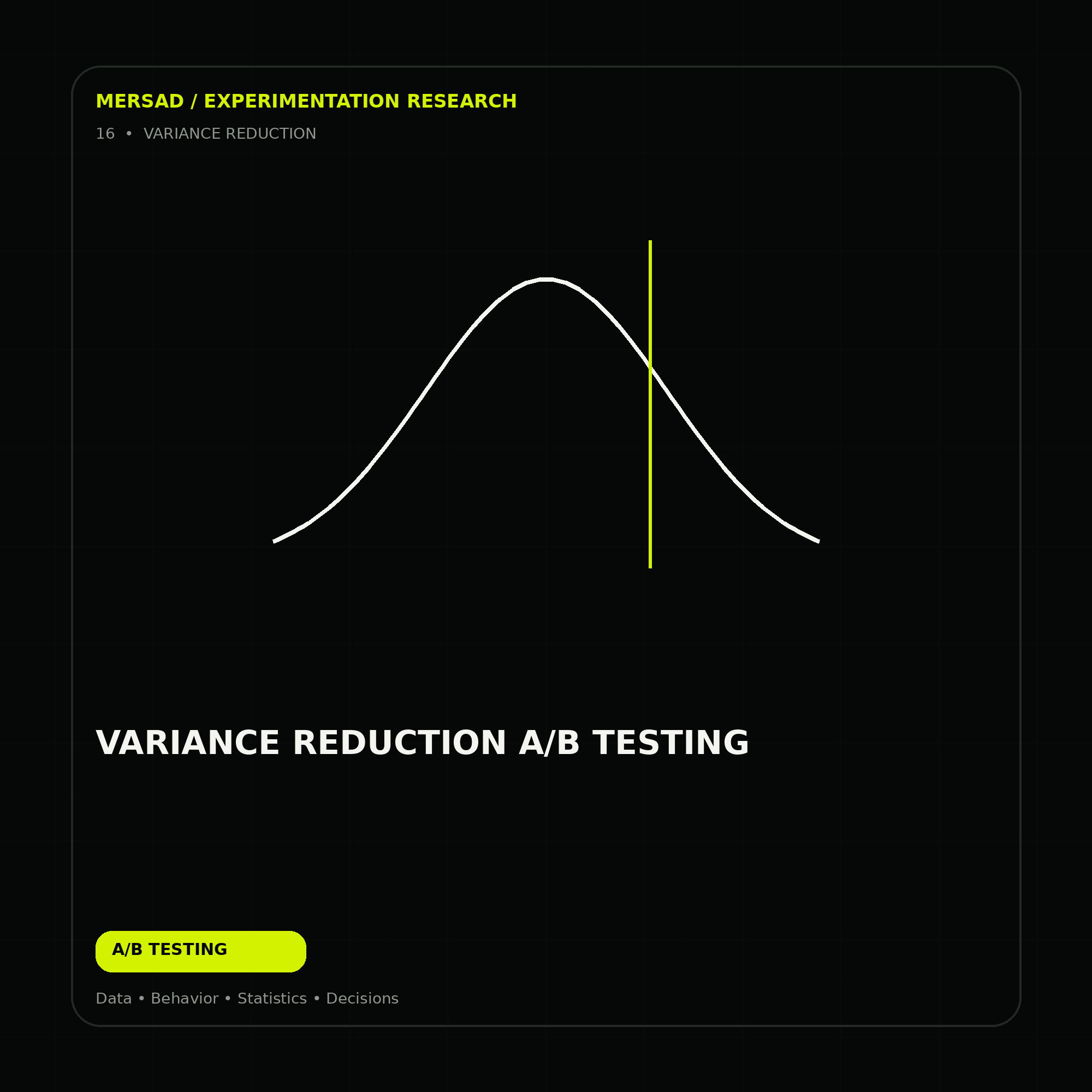
Experiment sensitivity depends on the signal-to-noise ratio. Better metric design and valid variance-reduction methods can make a test more informative without increasing traffic.
For ecommerce CRO teams, the practical standard is higher than producing a dashboard winner. The experiment must preserve causal validity, measure an outcome that matters commercially, survive data-quality checks, and support a decision that still makes sense after revenue quality, customer experience, and implementation cost are considered.
What variance reduction A/B testing Actually Means
variance reduction A/B testing belongs inside a complete online controlled experiment. Random assignment creates comparable groups, the treatment creates the intended difference, measurement captures outcomes, statistical analysis quantifies uncertainty, and the business decision determines whether the evidence is strong enough to act.
A systematic literature review of A/B testing analyzed 141 primary studies and found that classic controlled comparisons remain a dominant form of experimentation used for feature selection, rollout, and continued development. A separate modern statistical review describes the harder problems that appear at scale: sample planning, metric design, interference, sequential monitoring, heterogeneous effects, and trustworthy implementation. These are not academic side notes; they are the exact failure modes that can turn CRO testing into false confidence.
The Core Concepts Behind Variance Reduction
Metric Variance
Metric Variance matters because it changes either validity, sensitivity, interpretation, or commercial meaning. The rule should be defined before launch where possible, documented, and not retrofitted after the team sees which Variant is ahead.
In practice, this means the CRO team should ask what evidence supports the assumption, how the concept affects the analysis population, and whether a violation could create a false winner, hide a real effect, or distort the estimated business impact.
Regression Adjustment
Regression Adjustment matters because it changes either validity, sensitivity, interpretation, or commercial meaning. The rule should be defined before launch where possible, documented, and not retrofitted after the team sees which Variant is ahead.
In practice, this means the CRO team should ask what evidence supports the assumption, how the concept affects the analysis population, and whether a violation could create a false winner, hide a real effect, or distort the estimated business impact.
Stratification
Stratification matters because it changes either validity, sensitivity, interpretation, or commercial meaning. The rule should be defined before launch where possible, documented, and not retrofitted after the team sees which Variant is ahead.
In practice, this means the CRO team should ask what evidence supports the assumption, how the concept affects the analysis population, and whether a violation could create a false winner, hide a real effect, or distort the estimated business impact.
Robust Metrics
Robust Metrics matters because it changes either validity, sensitivity, interpretation, or commercial meaning. The rule should be defined before launch where possible, documented, and not retrofitted after the team sees which Variant is ahead.
In practice, this means the CRO team should ask what evidence supports the assumption, how the concept affects the analysis population, and whether a violation could create a false winner, hide a real effect, or distort the estimated business impact.
Historical Covariates
Historical Covariates matters because it changes either validity, sensitivity, interpretation, or commercial meaning. The rule should be defined before launch where possible, documented, and not retrofitted after the team sees which Variant is ahead.
In practice, this means the CRO team should ask what evidence supports the assumption, how the concept affects the analysis population, and whether a violation could create a false winner, hide a real effect, or distort the estimated business impact.
Simulation
Simulation matters because it changes either validity, sensitivity, interpretation, or commercial meaning. The rule should be defined before launch where possible, documented, and not retrofitted after the team sees which Variant is ahead.
In practice, this means the CRO team should ask what evidence supports the assumption, how the concept affects the analysis population, and whether a violation could create a false winner, hide a real effect, or distort the estimated business impact.
A Practical Ecommerce Example
Assume a high-traffic Product Page has strong product views but weak Add to Cart among first-time mobile visitors. Session recordings show repeated movement between the size selector and fit information, while support conversations contain recurring size questions. The team proposes an inline fit recommendation next to the selector.
A weak test would launch the new design and watch Add to Cart until the dashboard turns green. A stronger experiment defines the eligible audience, randomization unit, exposure event, Primary Metric, downstream Purchase Rate, size-related return guardrail, statistical method, sample plan, QA steps, and stopping rule before traffic enters the experiment.
The role of variance reduction A/B testing is to make one part of that decision system explicit. The statistical concept matters only when it changes what the team measures, how long it waits, how it interprets uncertainty, or whether it trusts the rollout.
How to Apply It in an Ecommerce Experiment
- Start with evidence from analytics, qualitative research, support data, technical logs, or previous experiments.
- Write a problem statement that identifies the affected audience and the behavior that is failing.
- Define a hypothesis that connects the proposed change to a plausible behavioral mechanism.
- Choose one decision-driving Primary Metric and document its denominator, unit, and maturity window.
- Add secondary metrics that explain the mechanism and guardrails that protect revenue, margin, customer experience, or technical health.
- Define eligibility, randomization, assignment persistence, and exposure before implementation.
- Plan the statistical method, effect threshold, sample requirement, and stopping behavior before reading results.
- Run functional, tracking, responsive, revenue, and allocation QA before launch.
- Check SRM, exposure quality, event integrity, and operational changes before interpreting uplift.
- Report effect size and uncertainty in business language, then document the decision and reusable learning.
How It Changes Sample Size and Experiment Runtime
Experiment planning connects baseline behavior, minimum practical effect, variance, statistical power, traffic allocation, and eligible traffic. Smaller effects require more information to distinguish from noise. Noisy metrics such as Revenue per Visitor often need more sample than frequent binary events. If a test would need several months to detect the smallest commercially relevant effect, the right decision may be to use a different validation method rather than force a weak purchase-level experiment.
Runtime has a business dimension too. Weekday and weekend behavior, payday effects, campaign launches, stock changes, delivery constraints, and promotions can alter the population entering the experiment. Reaching a sample target during an abnormal sale period does not automatically make the result representative of normal operations.
How to Think About Effect Size
Relative lift is useful for comparison, but absolute movement tells the business what changed in the real rate. A move from 2.0% to 2.2% is a 10% relative uplift and a 0.2 percentage-point absolute uplift. Both descriptions are correct. For commercial decisions, the team should translate the effect into incremental orders and then into revenue or gross margin using observed business data rather than invented benchmark assumptions.
The same relative uplift can have very different value across pages and segments. A small improvement at a high-volume Checkout step may matter more than a large improvement on a low-volume interaction. This is why experiment statistics should be connected to traffic volume, intent, and economic value.
Statistical Significance Is Not Business Significance
A statistically detectable uplift can still be a weak commercial decision. A Variant may increase Purchase Rate while lowering Average Order Value, using heavier discounts, increasing returns, or adding maintenance complexity. Every readout should therefore show Control and Treatment values, absolute and relative effect, uncertainty interval, sample and runtime, data-quality checks, important segment consistency, guardrails, and a commercial translation into orders, revenue, margin, or operational cost where the data supports it.
Common Mistakes
- Treating variance reduction A/B testing as a dashboard setting rather than an experiment-design decision.
- Choosing statistical rules after seeing the result.
- Using blended Conversion Rate without traffic-mix or segment context.
- Calling a click or Add to Cart uplift a revenue win without downstream validation.
- Ignoring SRM, exposure loss, duplicate purchase events, or inconsistent assignment.
- Testing an obvious bug instead of fixing it directly.
- Running many metrics and segments, then reporting only the positive one.
- Ignoring AOV, margin, returns, cancellations, payment failures, or performance.
- Copying competitor experiments without evidence that the same customer problem exists.
- Rolling out without production QA, monitoring, and a rollback path.
What to Validate Before Trusting the Result
- Data quality: Purchase and revenue events reconcile with the ecommerce platform closely enough for the decision.
- Randomization: The assignment ratio and persistence behave as planned.
- Exposure: Users counted in the treatment analysis had a valid opportunity to see or experience the change.
- Operational stability: Stock, pricing, shipping, promotions, and payment availability did not change in a way that explains the result.
- Segment consistency: Important predefined segments do not show a contradictory effect that changes the rollout decision.
- Metric maturity: Delayed outcomes such as returns, cancellations, or refunds have had enough time to appear.
How to Report the Result to a Business Team
A useful experiment readout leads with the decision. State what changed, who was eligible, what the Primary Metric did, how uncertain the estimate is, whether guardrails stayed healthy, and what the result means commercially. Then provide the technical evidence needed for auditability. This keeps statistics in service of the business rather than turning the report into a significance screenshot.
A concise decision statement can follow this structure: “The Variant changed [Primary Metric] by [estimated effect], with [uncertainty range]. Allocation and tracking checks passed. [Guardrail metrics] remained within the predefined acceptable range. Based on the commercial threshold and implementation risk, we recommend [roll out / do not roll out / follow-up test].”
Keyword and Search Intent Coverage
The primary search topic is variance reduction A/B testing. Supporting language includes A/B testing variance, experiment sensitivity, reduce A/B test sample size, CRO experiment sensitivity, regression adjustment. The objective is topical depth and search-intent match, not mechanical repetition. Closely related keywords are placed in Rank Math as additional focus terms, while the article body covers the entities and subproblems naturally.
Frequently Asked Questions
Is variance reduction A/B testing only relevant to large experimentation programs?
No. The concept matters whenever it changes whether a result can be trusted or acted on. Smaller teams may use simpler tooling, but the decision problem remains.
Should every ecommerce CRO idea become an A/B test?
No. Tracking failures, broken payments, incorrect information, severe usability defects, and basic accessibility fixes should normally be corrected directly.
Can a statistically valid test still be a bad business rollout?
Yes. Commercial value also depends on effect size, AOV, margin, returns, customer experience, implementation cost, and operational feasibility.
How many Rank Math focus keywords should this article use?
A focused set is better than a long list. The package uses the Primary Keyword plus closely related additional terms rather than unrelated keyword stuffing.
What should happen after an inconclusive result?
Check power, confidence interval, implementation validity, SRM, and whether the hypothesis should be refined, retested, or deprioritized.
Should the test be analyzed only on the overall audience?
No. Predefined critical segments can matter, but post-hoc slicing should be treated as exploratory unless the analysis properly addresses multiple comparisons and interaction effects.
Conclusion
variance reduction A/B testing matters because trustworthy experimentation is a decision system, not a winner generator. Strong CRO programs connect evidence, randomization, statistical discipline, customer behavior, commercial metrics, implementation quality, and organizational learning.
Mersad helps ecommerce teams build research-backed experimentation roadmaps, measurement plans, A/B test briefs, tracking specifications, QA processes, and result readouts that connect statistical evidence to revenue decisions.