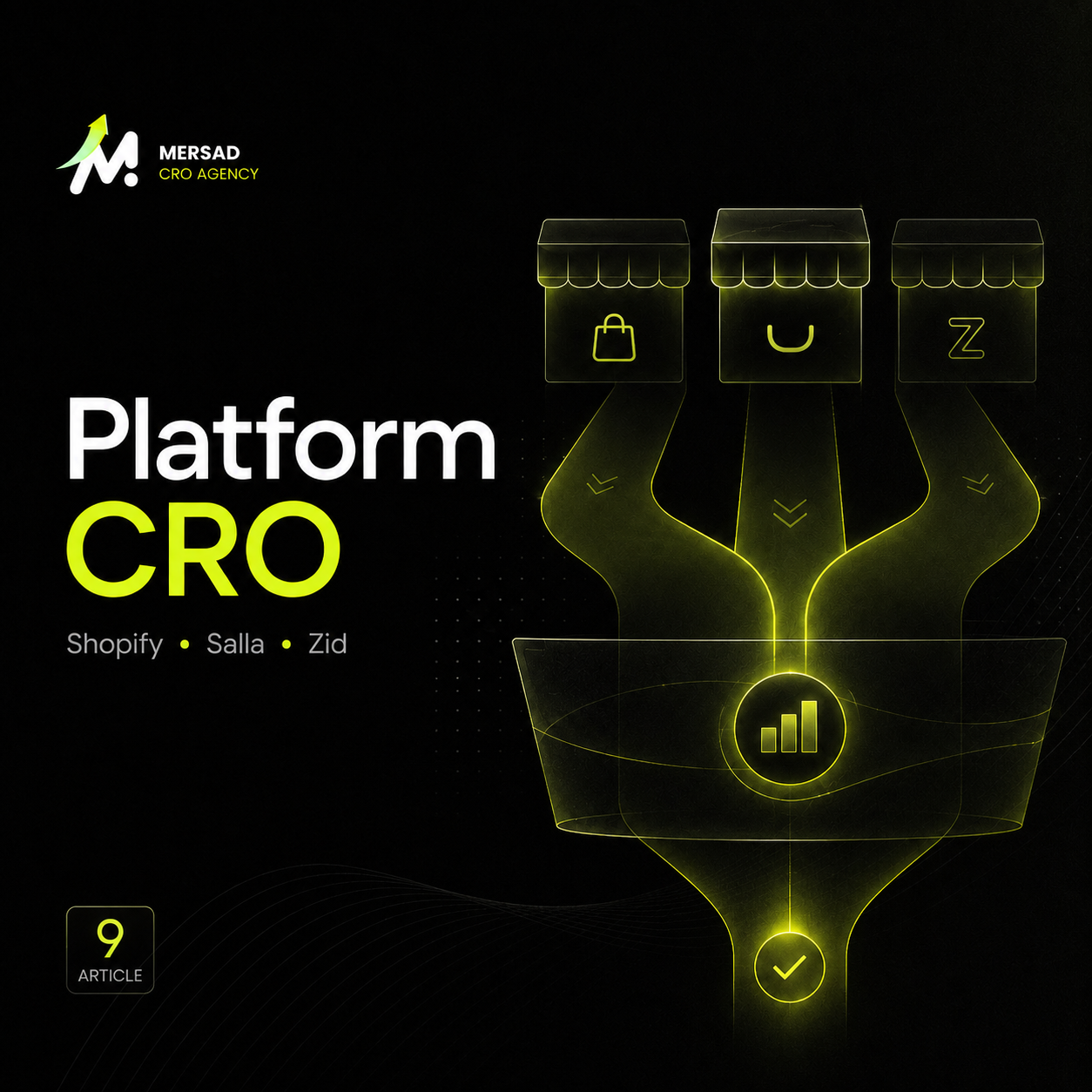
Shopify vs Salla vs Zid CRO: How Optimization Priorities Change by Platform
Shopify, Salla, and Zid can all support successful ecommerce growth, but CRO priorities change because each platform has different checkout control, theme architecture, app ecosystems, payment options, localization patterns, and technical constraints.
The correct question is not which platform has the highest universal Conversion Rate. The correct question is how to identify and optimize the biggest constraints inside the chosen platform and market.
What Remains the Same Across Platforms
- Tracking quality
- Traffic segmentation
- Product Page clarity
- Mobile usability
- Payment and delivery
- Funnel analysis
- Customer research
- Prioritization
- Experiment discipline
Shopify CRO Priorities
- Theme performance
- App and script load
- Product variant logic
- Shop Pay and wallet use
- International Markets
- Checkout extensibility
- Subscription and bundle apps
- Tracking and server-side data
Shopify offers a large ecosystem, but app accumulation can create speed, UX, and tracking complexity.
Salla CRO Priorities
- Saudi payment methods
- Mobile-first behavior
- Theme customization
- Shipping and city logic
- Promotion configuration
- Custom CSS and JavaScript risks
- Checkout limitations
- Arabic content and RTL
Salla optimization often requires close attention to local payment preferences, delivery communication, theme constraints, and reliable custom-code implementation.
Zid CRO Priorities
- Theme structure
- Product-card and variant logic
- Saudi operational integrations
- Payment and delivery
- Custom theme development
- Tracking consistency
- Mobile UX
- Catalog merchandising
Platform Comparison Areas
Checkout Control
The amount of control available over Checkout influences whether changes are direct fixes, app-based solutions, or experiments outside the final payment step.
Theme and Front-End Flexibility
Custom themes create opportunity and risk. Poorly governed custom code can introduce regressions, tracking issues, and mobile problems.
Apps and Integrations
Third-party tools can improve functionality but also create latency, duplicate events, visual inconsistency, and conflicting scripts.
Localization
Arabic, RTL, regional payments, delivery zones, VAT, and customer expectations must be considered in GCC markets.
A Platform-Neutral CRO Workflow
- Validate tracking.
- Segment traffic.
- Map the funnel.
- Review Product Pages and Product Lists.
- Analyze mobile behavior.
- Review payment and delivery.
- Identify platform constraints.
- Prioritize fixes and tests.
- Measure impact.
Do Not Use Platform Benchmarks as a Diagnosis
A platform name does not explain performance. Conversion depends on traffic quality, audience, price, product, device mix, brand strength, delivery, payment, and customer experience.
Tracking Across Platforms
Platform-native analytics and GA4 may differ in attribution, transaction timing, refund treatment, and user identity. Validate data before comparing performance.
Custom Code Governance
Custom CSS and JavaScript can enable useful experiments and improvements, but unmanaged code can create regressions. Maintain version control, documentation, QA, and rollback steps.
Payments in GCC Ecommerce
Payment availability, wallet adoption, installment options, COD policy, and gateway reliability can materially influence performance. Review by country, Device, and customer type.
Arabic and RTL Experience
Translation is not enough. Review hierarchy, typography, icon direction, form alignment, mixed Arabic-English content, and consistency across the journey.
Frequently Asked Questions
Which platform converts best?
No platform has a universally superior Conversion Rate. Performance depends on traffic, product, brand, market, price, operations, theme quality, and implementation.
Can the same CRO roadmap be used for all three?
The research framework can be shared, but implementation priorities and constraints differ.
Should a store migrate platforms to improve CRO?
Migration may be justified when platform constraints block the business, but it introduces cost and risk. Diagnose whether the current problem is truly platform-driven first.
Shopify Implementation Considerations
Review theme sections, app embeds, Checkout extensibility, customer accounts, localization, and Shopify Markets. Remove unnecessary app scripts and validate changes across theme templates.
Salla Implementation Considerations
Review theme capabilities, custom CSS and JavaScript, payment and shipping settings, promotion configuration, Arabic mobile layouts, and third-party widgets. Custom code should be isolated and tested to avoid affecting unrelated elements.
Zid Implementation Considerations
Review theme components, variant display, product cards, custom scripts, payment integrations, shipping rules, and mobile behavior. Catalog structure and merchandising can be particularly important for stores with large assortments.
Migration Versus Optimization
Do not recommend migration before identifying the real constraint. A platform change introduces SEO, tracking, design, operational, and data-migration risk. Optimize the current platform when the problem is implementation or strategy rather than a hard platform limitation.
Platform CRO Audit Checklist
- Tracking and attribution
- Theme performance
- Mobile navigation
- Product-card and Product Page behavior
- Checkout control
- Payments and delivery
- Apps and third-party scripts
- Arabic and RTL quality
- Promotion and VAT logic
- Experimentation feasibility
Conclusion
Shopify, Salla, and Zid require different implementation tactics, but the CRO principles remain consistent: reliable data, customer understanding, prioritized action, and commercial measurement.
Mersad works across Shopify, Salla, Zid, WooCommerce, and custom stores to adapt CRO strategy to platform constraints and market conditions.