Revenue per Click for Ecommerce: A Better Bridge Between Media and CRO
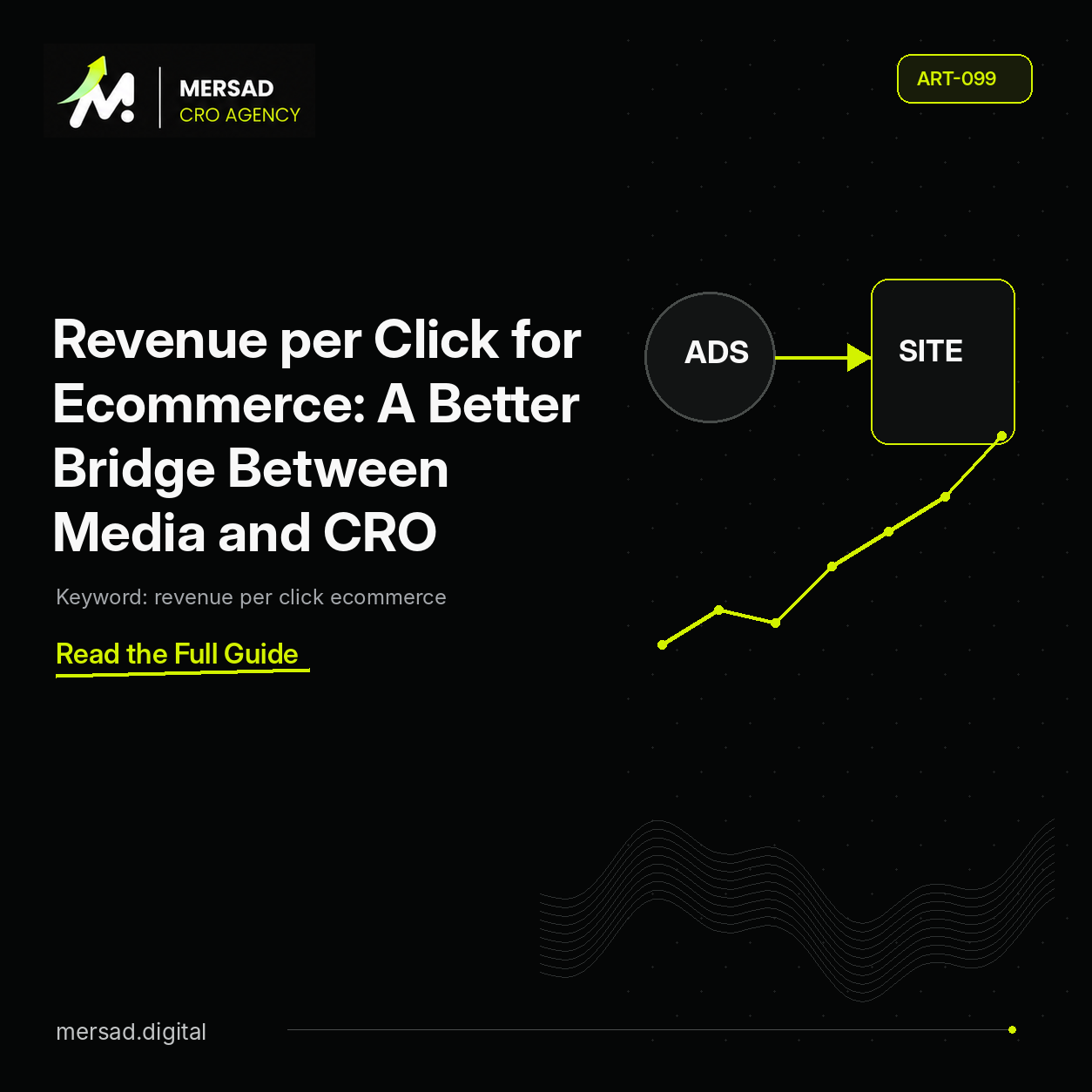
Revenue per click ecommerce sits between media buying and onsite conversion. An ad can generate efficient clicks while the post-click journey loses qualified demand, and a website can appear to convert poorly simply because campaign mix changed.
The right analysis connects campaign, landing page, product progression, cart, checkout, revenue per session, and customer intent so the media and CRO teams optimize the same commercial outcome. For revenue per click ecommerce, connect the finding back to the specific campaign, landing page, and post-click revenue path rather than judging media or the website in isolation.
What revenue per click ecommerce actually means
In practical ecommerce work, revenue per click should be evaluated as part of a system. A store can improve one metric and damage another. It can also look weaker in aggregate while an important segment is improving.
A useful analysis asks:
- What changed?
- When did it change?
- Which users or sessions contributed most?
- Which funnel transition changed?
- Did traffic quality, product mix, pricing, stock, delivery, payment, or tracking change?
- What is confirmed evidence versus a hypothesis?
- Which action can be implemented directly, and which requires validation?
- Campaign-specific check: connect this to the campaign and landing page used for revenue per click ecommerce.
For revenue per click ecommerce, connect the finding back to the specific campaign, landing page, and post-click revenue path rather than judging media or the website in isolation.
That structure prevents the most common failure in CRO work: jumping from a metric to a design idea without proving that the design is the cause. For revenue per click ecommerce, connect the finding back to the specific campaign, landing page, and post-click revenue path rather than judging media or the website in isolation.
For this topic, the next decision should be based on evidence around revenue per click, especially revenue per click and conversion rate.
Why post-click efficiency matters to paid media
The impact of revenue per click ecommerce should be expressed through revenue efficiency, not only page engagement.
The core relationship is:
Revenue = Sessions × Conversion Rate × Average Order Value
For deeper analysis, add revenue per session because it connects traffic volume, conversion, and basket value in one efficiency metric. In this revenue per click ecommerce context, the key is to isolate the affected campaign before generalizing.
The metrics most relevant to this topic include revenue per click, conversion rate, AOV, CPC, and ROAS. The exact primary metric depends on the stage being analyzed. A product-discovery change may first influence product-view progression, while a checkout intervention may be judged on purchase completion. The metric should follow the hypothesized behavior.
Connect campaign metrics to onsite outcomes
Before looking for opportunities, define a baseline.
Use a comparison period that makes business sense. Record:
- Sessions
- Users where useful
- Orders
- Revenue
- Conversion rate
- AOV
- Revenue per session
- Product views
- Add to cart
- Begin checkout
- Purchase
- Campaign-specific check: connect this to the campaign and landing page used for this post-click performance analysis.
- ART-099 context: apply this checklist to the specific decision and affected audience for this article.
For this post-click performance analysis, connect the finding back to the specific campaign, landing page, and post-click revenue path rather than judging media or the website in isolation. For ART-099, keep this point scoped to the evidence and audience relevant to that decision.
Then document known context:
- Promotions
- Major campaigns
- Product launches
- Stock issues
- Shipping changes
- Payment incidents
- Theme or app releases
- Tracking deployments
- Campaign-specific check: connect this to the campaign and landing page used for this post-click performance analysis.
- ART-099 context: apply this checklist to the specific decision and affected audience for this article.
For this post-click performance analysis, connect the finding back to the specific campaign, landing page, and post-click revenue path rather than judging media or the website in isolation. For ART-099, keep this point scoped to the evidence and audience relevant to that decision.
Without that context, a normal business change can be misread as a conversion problem.
Validate measurement before optimizing
No this post-click performance analysis analysis is stronger than its measurement.
If GA4 is part of the stack, validate ecommerce events such as view_item, add_to_cart, begin_checkout, add_shipping_info, add_payment_info, and purchase where the implementation supports them. For this post-click performance analysis, connect the finding back to the specific campaign, landing page, and post-click revenue path rather than judging media or the website in isolation. For ART-099, keep this point scoped to the evidence and audience relevant to that decision.
Check:
- Does the event fire on the real action?
- Does it fire once?
- Are item IDs and values correct?
- Does purchase revenue reconcile reasonably with the commerce platform?
- Are transaction IDs present?
- Did consent, payment redirects, or cross-domain behavior change? This matters to this post-click performance analysis because the same symptom can come from different traffic, product, or operational causes.
A broken event is a tracking defect, not an A/B testing opportunity.
Break performance down by campaign and landing page
Blended averages are useful for monitoring and dangerous for diagnosis.
For this post-click performance analysis, begin with campaign, creative, device, landing page, and audience.
A useful segment table is:
| Segment | Traffic | Primary Rate | Revenue / Session | Change | Contribution |
|—|—:|—:|—:|—:|—:|
| Mobile | — | — | — | — | — |
| Paid Social | — | — | — | — | — |
| Priority market | — | — | — | — | — |
| Priority category | — | — | — | — | — | For this post-click performance analysis, connect the finding back to the specific campaign, landing page, and post-click revenue path rather than judging media or the website in isolation.
Do not insert invented benchmarks. Use the store’s own history, comparable periods, and relevant internal segments. For this post-click performance analysis, connect the finding back to the specific campaign, landing page, and post-click revenue path rather than judging media or the website in isolation. For ART-099, keep this point scoped to the evidence and audience relevant to that decision.
Separate click volume from revenue efficiency
A store can receive more traffic while producing fewer orders.
It can also receive less traffic and produce more revenue.
That is why every this post-click performance analysis investigation should separate:
Volume
How many qualified sessions/users reached the relevant journey?
Efficiency
What percentage progressed?
Value
How much revenue or margin did the journey produce?
When these move in different directions, the analysis becomes more informative.
Find where the post-click journey loses intent
A general ecommerce funnel can be represented as:
Landing → Product discovery → Product view → Add to cart → Cart → Begin checkout → Shipping → Payment → Purchase For this post-click performance analysis, connect the finding back to the specific campaign, landing page, and post-click revenue path rather than judging media or the website in isolation. For ART-099, keep this point scoped to the evidence and audience relevant to that decision.
You do not need every step in every analysis.
Choose the minimum sequence that isolates the decision relevant to this post-click performance analysis.
For each transition calculate:
Progression rate = Users reaching next step ÷ Users at current step
Then ask:
- Which transition changed most?
- Which transition affects the largest number of commercially relevant users?
- Is the issue isolated to one segment?
- Is the pattern new or persistent?
- Campaign-specific check: connect this to the campaign and landing page used for this post-click performance analysis.
- ART-099 context: apply this checklist to the specific decision and affected audience for this article.
For this post-click performance analysis, connect the finding back to the specific campaign, landing page, and post-click revenue path rather than judging media or the website in isolation. For ART-099, keep this point scoped to the evidence and audience relevant to that decision.
The largest percentage drop is not automatically the largest business opportunity.
Quantify contribution without pretending causality
A useful diagnostic estimate is:
Expected outcomes at previous rate = Current exposed users × Previous progression rate
Then:
Gap = Expected outcomes − Actual outcomes
This helps identify where the business lost the most progression relative to its own prior performance. For this post-click performance analysis, connect the finding back to the specific campaign, landing page, and post-click revenue path rather than judging media or the website in isolation. For ART-099, keep this point scoped to the evidence and audience relevant to that decision.
For this topic, the next decision should be based on evidence around revenue per click, especially revenue per click and conversion rate.
It does not prove that fixing a UX issue will recover the full gap. Traffic, product mix, seasonality, pricing, stock, and operations may also contribute. For this post-click performance analysis, connect the finding back to the specific campaign, landing page, and post-click revenue path rather than judging media or the website in isolation. For ART-099, keep this point scoped to the evidence and audience relevant to that decision.
Use the number to prioritize investigation, not to promise uplift.
Diagnose campaign quality before blaming the site
Before blaming the interface, compare the quality and allocation of traffic.
For this post-click performance analysis, check whether:
- A lower-intent channel grew as a share of sessions
- New visitors increased faster than returning visitors
- Campaigns started landing on a different page
- A broader audience entered the funnel
- The device mix changed materially
- Geographic mix changed
- Promotions attracted coupon-seeking traffic
- Campaign-specific check: connect this to the campaign and landing page used for this post-click performance analysis.
- ART-099 context: apply this checklist to the specific decision and affected audience for this article.
For this post-click performance analysis, connect the finding back to the specific campaign, landing page, and post-click revenue path rather than judging media or the website in isolation. For ART-099, keep this point scoped to the evidence and audience relevant to that decision.
If segment-level conversion is stable but the blended rate changes, the customer mix may explain much of the movement. For this post-click performance analysis, connect the finding back to the specific campaign, landing page, and post-click revenue path rather than judging media or the website in isolation. For ART-099, keep this point scoped to the evidence and audience relevant to that decision.
Evaluate product and merchandising context
Conversion is influenced by what people are being asked to buy.
Check:
- Product/category mix
- Price band
- Stock
- Variant availability
- Best-seller availability
- Promotion exposure
- Product launches
- Collection merchandising
- Campaign-specific check: connect this to the campaign and landing page used for this post-click performance analysis.
- ART-099 context: apply this checklist to the specific decision and affected audience for this article.
For this post-click performance analysis, connect the finding back to the specific campaign, landing page, and post-click revenue path rather than judging media or the website in isolation. For ART-099, keep this point scoped to the evidence and audience relevant to that decision.
A high-consideration category should not be judged exactly like a low-price replenishment category. In this this post-click performance analysis context, the key is to isolate the affected campaign before generalizing.
The goal is not to normalize every product into one rate. It is to compare like with like.
Evaluate the user experience at the affected stage
Once the weak stage is identified, review the experience there.
Depending on the topic, this may include:
- Navigation
- Search
- Filters
- Product cards
- Product information
- Images
- Variants
- Price
- Delivery
- Returns
- Reviews
- CTA state
- Cart controls
- Checkout forms
- Payment methods
- Error handling
- Campaign-specific check: connect this to the campaign and landing page used for this post-click performance analysis.
- ART-099 context: apply this checklist to the specific decision and affected audience for this article.
For this post-click performance analysis, connect the finding back to the specific campaign, landing page, and post-click revenue path rather than judging media or the website in isolation. For ART-099, keep this point scoped to the evidence and audience relevant to that decision.
A heuristic review is valuable when it is tied to the diagnosed stage. It is weaker when it becomes a sitewide list of preferences. For this post-click performance analysis, connect the finding back to the specific campaign, landing page, and post-click revenue path rather than judging media or the website in isolation. For ART-099, keep this point scoped to the evidence and audience relevant to that decision.
Use behavioral evidence to explain the metric
Quantitative analysis tells you where to investigate.
Qualitative research helps explain why.
Use:
- Session recordings
- Heatmaps
- On-site surveys
- User testing
- Search logs
- Customer reviews
- Support tickets
- Chat/WhatsApp themes
- Sales or account-team feedback
- Campaign-specific check: connect this to the campaign and landing page used for this post-click performance analysis.
- ART-099 context: apply this checklist to the specific decision and affected audience for this article.
For this post-click performance analysis, connect the finding back to the specific campaign, landing page, and post-click revenue path rather than judging media or the website in isolation. For ART-099, keep this point scoped to the evidence and audience relevant to that decision.
Create cohorts.
If the issue affects mobile PDP users, review mobile PDP sessions. If it affects shipping-stage abandonment in Saudi Arabia, investigate that specific flow. This matters to this post-click performance analysis because the same symptom can come from different traffic, product, or operational causes.
Randomly watching sessions produces anecdotes. Cohort-based research produces stronger hypotheses.
Build an evidence ladder
Use explicit labels.
Confirmed finding
A measurable change supported by data.
Observation
A repeated behavior seen in research.
Hypothesis
A proposed explanation that is not yet proven.
Recommendation
The action chosen based on evidence, business impact, and feasibility.
This is especially important for this post-click performance analysis, because several plausible causes can produce the same top-level metric. For ART-099, keep this point scoped to the evidence and audience relevant to that decision.
Failure modes to avoid
Three risks deserve special attention:
- Treating rpc as causal
- Ignoring margin
- Using it without click-quality context
Another mistake is turning every issue into an A/B test. Broken tracking, incorrect links, payment failures, severe mobile bugs, and objectively wrong content should be fixed directly. For this post-click performance analysis, connect the finding back to the specific campaign, landing page, and post-click revenue path rather than judging media or the website in isolation. For ART-099, keep this point scoped to the evidence and audience relevant to that decision.
Experiment when multiple valid solutions exist and customer response is uncertain.
Turn the diagnosis into an action brief
For each opportunity, document:
Issue
What is wrong?
Evidence
Which data or research supports it?
Impact
How many relevant users are exposed and where in the funnel?
Recommendation
What should change?
Why it may work
Which user or business mechanism does it address?
Priority
Critical, High, Medium, or Low.
Effort
What design, development, analytics, or operational work is required?
Owner
Who is accountable?
Required validation
What is still unknown?
Success metric
What should improve if the action works?
This converts this post-click performance analysis from an article topic into an executable operating process.
Prioritize by exposure, evidence, and effort
Critical
- Checkout blockers
- Payment failure
- Tracking failure
- Dead CTA
- Incorrect pricing
- Severe mobile defect For this post-click performance analysis, connect the finding back to the specific campaign, landing page, and post-click revenue path rather than judging media or the website in isolation. For ART-099, keep this point scoped to the evidence and audience relevant to that decision.
High
Strong evidence + meaningful exposure + commercial relevance.
Medium
Reasonable opportunity with incomplete validation.
Low
Minor enhancement or low-exposure improvement.
Prioritization should reflect impact, confidence, effort, urgency, and implementation complexity. For this post-click performance analysis, connect the finding back to the specific campaign, landing page, and post-click revenue path rather than judging media or the website in isolation. For ART-099, keep this point scoped to the evidence and audience relevant to that decision.
What to fix directly
The following usually do not need an experiment:
- Broken links
- Incorrect destinations
- Duplicated purchase events
- Inaccessible form controls
- Out-of-stock products advertised as available
- Payment errors
- Missing required information caused by a defect
- Campaign-specific check: connect this to the campaign and landing page used for this post-click performance analysis.
- ART-099 context: apply this checklist to the specific decision and affected audience for this article.
For this post-click performance analysis, connect the finding back to the specific campaign, landing page, and post-click revenue path rather than judging media or the website in isolation. For ART-099, keep this point scoped to the evidence and audience relevant to that decision.
Measure after the fix, but do not waste traffic asking whether the broken version should remain.
What may deserve an experiment
Testing can be appropriate for:
- Information hierarchy
- CTA presentation
- Size guidance
- Product-card content
- Filter discoverability
- Delivery messaging
- Social-proof presentation
- Upsell structure
- Campaign-specific check: connect this to the campaign and landing page used for this post-click performance analysis.
- ART-099 context: apply this checklist to the specific decision and affected audience for this article.
For this post-click performance analysis, connect the finding back to the specific campaign, landing page, and post-click revenue path rather than judging media or the website in isolation. For ART-099, keep this point scoped to the evidence and audience relevant to that decision.
Only test when:
- Tracking is reliable
- Sample is feasible
- The change has material exposure
- The hypothesis is based on evidence
- Guardrails are defined
- Campaign-specific check: connect this to the campaign and landing page used for this post-click performance analysis.
- ART-099 context: apply this checklist to the specific decision and affected audience for this article.
For this post-click performance analysis, connect the finding back to the specific campaign, landing page, and post-click revenue path rather than judging media or the website in isolation. For ART-099, keep this point scoped to the evidence and audience relevant to that decision.
The core action sequence
For this post-click performance analysis, the recommended sequence is:
- Calculate rpc consistently
- Compare by campaign and landing
- Pair it with conversion/aov
- Use it as a bridge metric rather than a sole kpi
- Prioritize fixes, research, and experiments
- QA implementation
- Monitor the affected segment after release
That sequence is deliberately diagnosis-first.
KPI framework for this post-click performance analysis
Use a small metric tree.
Business
- Revenue
- Orders
- Margin where available
Efficiency
- Conversion rate
- Revenue per session
- AOV
Funnel
- Relevant progression rate
- Error rate where applicable
Experience
- Task-specific behavioral metrics
- Search/variant/form interactions
Guardrails
- Returns
- Refunds
- Page performance
- Support contacts
Do not optimize micro-metrics without showing how they connect to the intended customer behavior. In this this post-click performance analysis context, the key is to isolate the affected campaign before generalizing.
FAQ
What is this post-click performance analysis?
It is the structured analysis and optimization of revenue per click, using ecommerce data, customer behavior, UX, operational context, and experimentation where appropriate.
Which metrics should I use?
Start with revenue per click, conversion rate, AOV, and CPC. Add funnel-stage and guardrail metrics that match the problem. Avoid managing the topic through one blended metric.
How do I know whether the website is actually the problem?
Validate measurement, traffic mix, product mix, stock, promotion, shipping, and payment first. If those are stable and the loss is concentrated in a specific experience stage, onsite friction becomes more plausible. This matters to this post-click performance analysis because the same symptom can come from different traffic, product, or operational causes.
For this topic, the next decision should be based on evidence around revenue per click, especially revenue per click and conversion rate.
Should I use an industry conversion benchmark?
External benchmarks can provide context, but they should not replace internal comparisons by device, channel, product, customer type, and period. Business models vary too much for one universal target. For this post-click performance analysis, connect the finding back to the specific campaign, landing page, and post-click revenue path rather than judging media or the website in isolation. For ART-099, keep this point scoped to the evidence and audience relevant to that decision.
Should this become an A/B test?
Only when customer response is genuinely uncertain and the test has enough eligible traffic. Fix objective defects directly. For this post-click performance analysis, connect the finding back to the specific campaign, landing page, and post-click revenue path rather than judging media or the website in isolation. For ART-099, keep this point scoped to the evidence and audience relevant to that decision.
How long should the analysis take?
It depends on traffic, data quality, catalog complexity, number of markets, and research depth. The objective is not to spend a fixed number of days; it is to reach a decision with enough evidence. For this post-click performance analysis, connect the finding back to the specific campaign, landing page, and post-click revenue path rather than judging media or the website in isolation. For ART-099, keep this point scoped to the evidence and audience relevant to that decision.
What is the final deliverable?
A strong output includes the key finding, supporting evidence, business impact, recommended action, priority, owner, required validation, and success metric. For this post-click performance analysis, connect the finding back to the specific campaign, landing page, and post-click revenue path rather than judging media or the website in isolation. For ART-099, keep this point scoped to the evidence and audience relevant to that decision.
Final takeaway
The value of this post-click performance analysis is not the number of tactics it generates.
Its value is the quality of the decision.
A strong process connects data, customer behavior, psychology, UX, operations, and business strategy so the team can identify the highest-value constraint and act with the right level of confidence. For this post-click performance analysis, connect the finding back to the specific campaign, landing page, and post-click revenue path rather than judging media or the website in isolation. For ART-099, keep this point scoped to the evidence and audience relevant to that decision.
Sources and further reading
- Shopify — CRO checklist
- Google Analytics — Funnel explorations for ecommerce
- Campaign-specific check: connect this to the campaign and landing page used for this post-click performance analysis.
- ART-099 context: apply this checklist to the specific decision and affected audience for this article.
For this post-click performance analysis, connect the finding back to the specific campaign, landing page, and post-click revenue path rather than judging media or the website in isolation. For ART-099, keep this point scoped to the evidence and audience relevant to that decision.
Related Mersad research
- Increase ecommerce conversion without more traffic
- Ecommerce funnel analysis guide
- Explore Mersad services
- Campaign-specific check: connect this to the campaign and landing page used for this post-click performance analysis.
- ART-099 context: apply this checklist to the specific decision and affected audience for this article.
For this post-click performance analysis, connect the finding back to the specific campaign, landing page, and post-click revenue path rather than judging media or the website in isolation. For ART-099, keep this point scoped to the evidence and audience relevant to that decision.
If you want Mersad to diagnose this problem across analytics, UX, and implementation, explore the ecommerce growth services or start a conversation. For ART-099, keep this point scoped to the evidence and audience relevant to that decision.