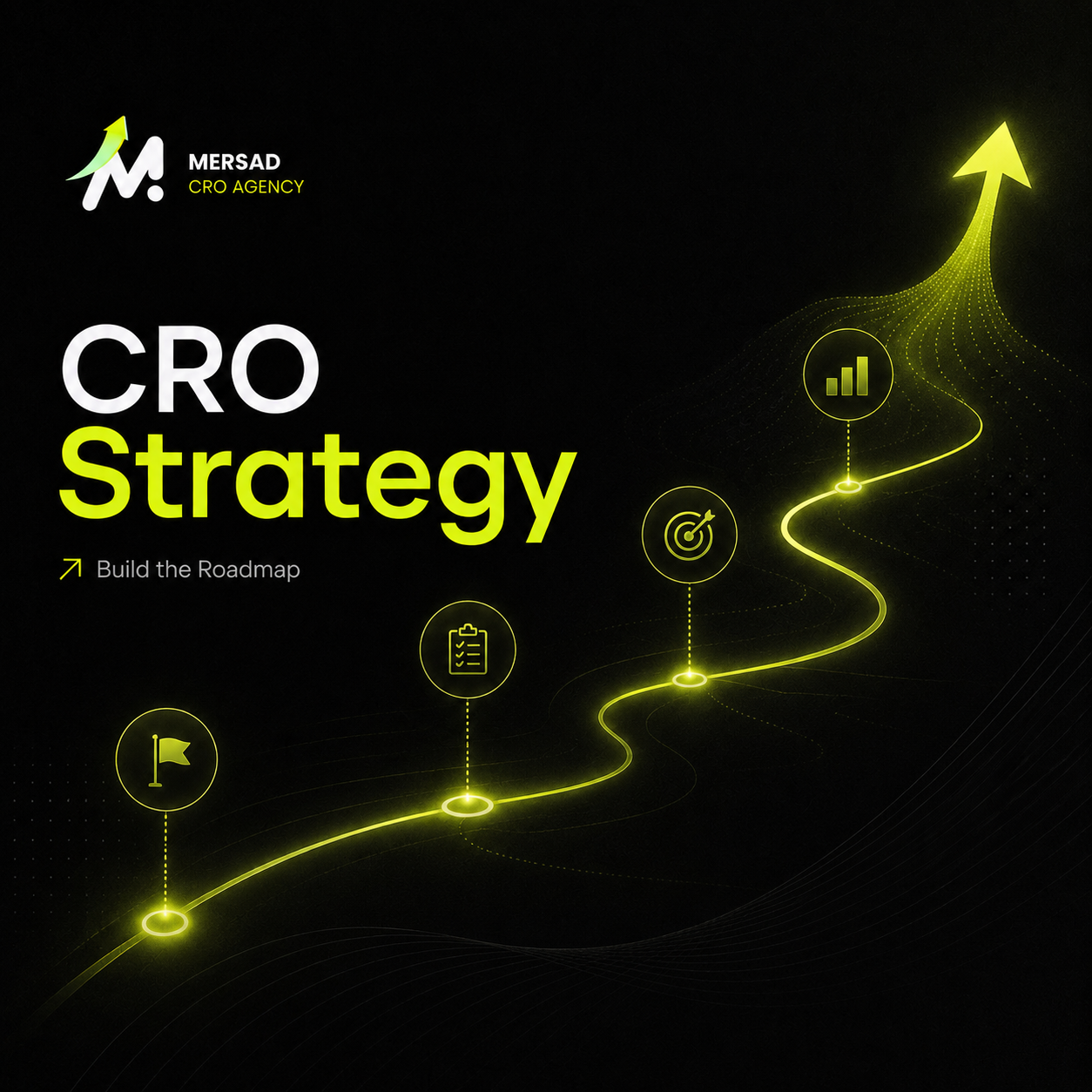
CRO Strategy: How to Build an Ecommerce Optimization Roadmap
A CRO strategy is the system that determines what the business investigates, prioritizes, implements, tests, measures, and learns. Without a strategy, optimization becomes a queue of disconnected ideas.
The Difference Between CRO Ideas and a CRO Strategy
Ideas answer what could change. Strategy explains why the change matters, what evidence supports it, which audience is affected, how success will be measured, and how the result changes future decisions.
The CRO Strategy Cycle
- Measurement
- Research
- Diagnosis
- Prioritization
- Implementation
- Experimentation
- Analysis
- Learning
Step 1: Define Commercial Objectives
- Increase Revenue per Session
- Improve Checkout Completion
- Increase New Customer Conversion
- Protect margin
- Improve mobile efficiency
- Increase repeat purchase
Step 2: Validate Measurement
A strategy built on unreliable tracking creates false priorities. Verify ecommerce events, revenue, campaign attribution, and key segment definitions.
Step 3: Build a Research Program
- GA4 analysis
- Product and category analysis
- Session recordings
- Surveys
- Support tickets
- Reviews
- Usability testing
- Competitive research
- Operational data
Step 4: Create Opportunity Areas
Group individual findings into strategic themes such as Product Page uncertainty, mobile Checkout friction, weak product discovery, payment failure, or new-customer trust.
Step 5: Prioritize
Use Impact × Confidence × Effort, then add urgency, traffic feasibility, and strategic learning.
Step 6: Build a Roadmap
A roadmap should balance critical fixes, direct improvements, experiments, research tasks, and measurement work.
- Critical bugs
- Tracking improvements
- High-confidence UX changes
- Experiments
- Qualitative research
- Operational dependencies
Step 7: Write Clear Briefs
- Objective
- Background
- Evidence
- Scope
- Deliverables
- Requirements
- Tracking
- QA
- Acceptance criteria
- Owner
- Dependencies
- Success metric
Step 8: Measure and Learn
Every completed initiative should update the knowledge base. Document what changed, what happened, what segments were affected, what the business learned, and what happens next.
CRO Roadmap Governance
- Weekly review
- Monthly prioritization
- Experiment readouts
- Cross-functional ownership
- Decision log
- Backlog hygiene
Common Strategy Failures
- Too many small tests
- No tracking QA
- No operational involvement
- No customer research
- No clear Primary Metric
- No documentation
- No segment analysis
- No commercial threshold
How to Balance the CRO Backlog
A healthy roadmap includes measurement work, critical fixes, high-confidence improvements, experiments, research, and operational dependencies. A backlog containing only A/B tests usually ignores important prerequisites.
Quarterly CRO Planning
- Review business goals and performance.
- Refresh the opportunity map.
- Estimate impact and feasibility.
- Confirm team capacity.
- Select strategic themes.
- Define measurement and learning goals.
Cross-Functional Ownership
CRO depends on analytics, design, development, merchandising, performance marketing, customer support, and operations. Assign an owner and dependencies to every initiative.
How to Measure the CRO Program
- Revenue impact of implemented improvements.
- Experiment velocity and quality.
- Percentage of roadmap supported by evidence.
- Time from finding to decision.
- Tracking and QA failure rate.
- Reusable learnings documented.
Frequently Asked Questions
How many experiments should a CRO team run?
The correct number depends on traffic, development capacity, and test quality. High velocity without strong hypotheses can create noise rather than learning.
What belongs in a CRO roadmap?
Research, tracking, direct fixes, UX improvements, experiments, operational actions, and measurement tasks.
How often should priorities change?
Review priorities when new evidence, business conditions, traffic, stock, campaigns, or operational constraints change.
Strategic Themes Versus Individual Tasks
Group related findings into themes. Ten small Product Page issues may represent one larger theme: first-time customers cannot evaluate product suitability. Themes create better coordination and stronger experiments than isolated cosmetic tasks.
Roadmap Horizons
Now
Critical bugs, tracking failures, severe revenue leakage, and low-effort high-confidence fixes.
Next
Validated opportunities requiring design, development, or cross-functional preparation.
Later
Research areas, larger platform work, and ideas waiting for evidence or traffic.
Decision Rules
Define in advance what happens after each initiative. A direct fix should have a monitoring plan. An experiment should have rollout criteria. Research should have a clear decision it is intended to inform.
CRO Team Roles
- CRO Lead: strategy, prioritization, hypotheses, and decisions.
- Analyst: data quality, funnel analysis, and measurement.
- UX Researcher: customer evidence and usability.
- Designer: solution design and prototypes.
- Developer: implementation and technical QA.
- Operations: stock, delivery, payment, and support feasibility.
- Marketing: traffic, audience, and campaign context.
Conclusion
A CRO strategy transforms optimization from reactive design work into a repeatable commercial capability.
Mersad helps ecommerce businesses build research programs, opportunity backlogs, prioritized roadmaps, experiment systems, and decision frameworks.