Product Page Optimization: A Research-Backed CRO Framework for Ecommerce
The Product Page is where interest becomes evaluation. Customers decide whether the product fits their needs, whether the price is justified, whether they can choose the right option, and whether buying feels safe.
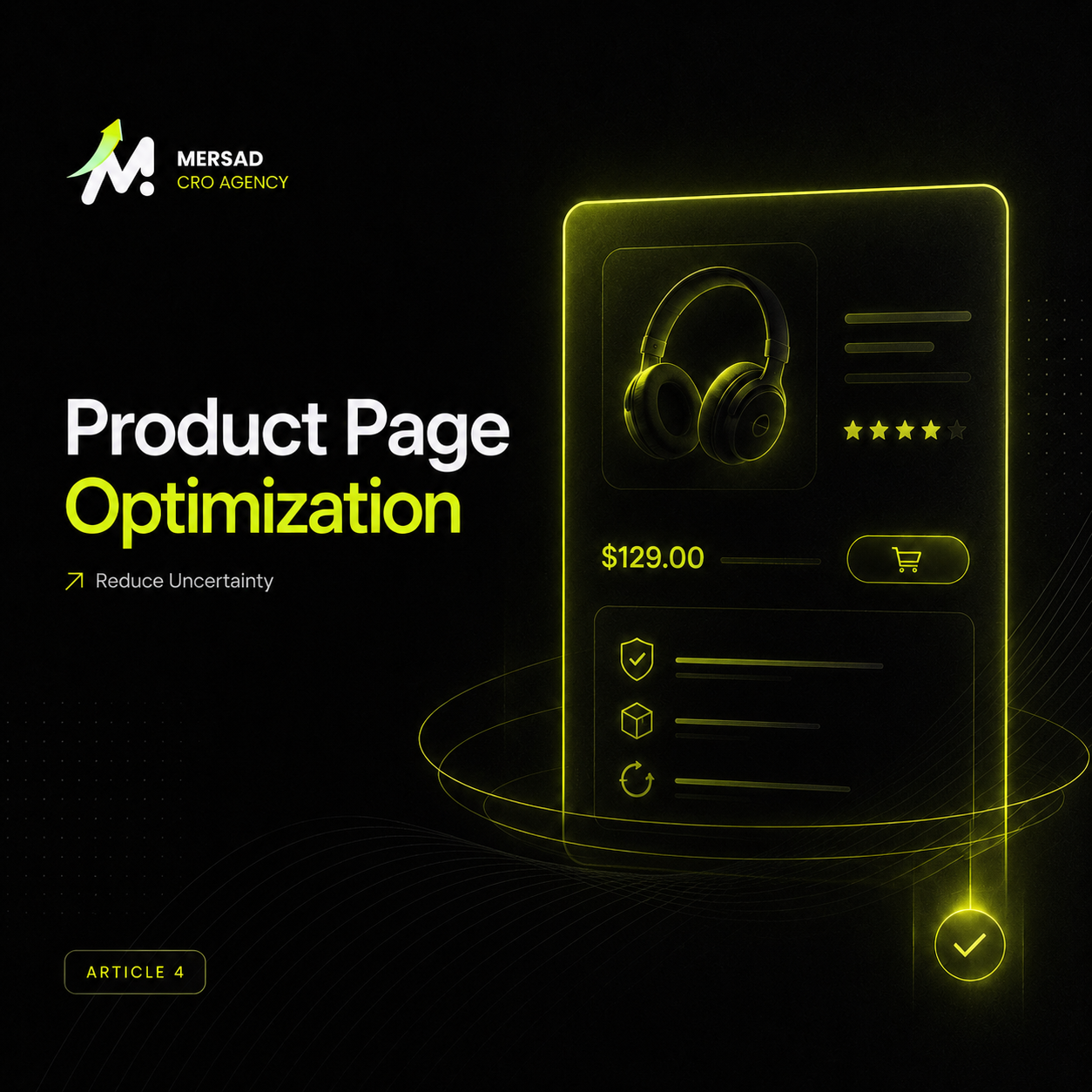
Product Page optimization is therefore not about adding more badges or moving the Add to Cart button without evidence. It is about reducing uncertainty, improving product understanding, and making the decision easier.
The Product Page Decision Model
- Identify the product
- Understand the value
- Evaluate price
- Choose the correct variant
- Reduce uncertainty
- Trust the store
- Take action
Value Proposition and Product Clarity
The page should explain what the product is, who it is for, why it is different, and what practical outcome it supports. Features without context create information, not value.
Images and Video as Evidence
- Scale and dimensions
- Texture and material
- Fit and movement
- Front, back, and details
- Packaging
- Real-world use
- Variant-specific media
The goal is not the largest number of images. The goal is to answer the customer’s visual questions.
Variant and Size Selection
Variant friction can reduce Add to Cart even when product interest is high. Labels should be clear, unavailable combinations should be disabled, and size guidance should be accessible near the selector.
- Show selected state clearly.
- Use meaningful color and size labels.
- Preserve selection when media changes.
- Explain stock by variant.
- Avoid forcing customers to guess compatibility.
Price and Offer Clarity
Customers should understand the selling price, original price, discount logic, bundle conditions, subscription terms, and shipping threshold without manual calculation.
Delivery and Returns
Delivery and returns are part of the Product Page decision. Customers often need to know when the product will arrive and what happens if it does not fit or meet expectations.
Reviews That Reduce Risk
- Verified purchase
- Photos and video
- Fit and usage feedback
- Filters by rating or variant
- Helpful review sorting
- Brand responses
- Visible negative reviews
Add to Cart and Mobile Layout
The primary action should be visible and understandable, but visibility alone is not enough. The customer must be able to complete required selections and understand what happens after clicking.
Product Page Metrics
- Product View to Add to Cart
- Revenue per Product View
- Variant selection completion
- Size Guide interaction
- Review interaction
- Cart removal
- Return rate by product
- Mobile vs desktop performance
- New vs returning performance
How to Diagnose a Weak Product Page
- Segment performance.
- Review Product View to Add to Cart.
- Check traffic quality.
- Analyze variant and content interaction.
- Review session recordings.
- Analyze support and return reasons.
- Compare mobile and desktop.
- Validate technical performance.
What to Fix Directly
- Broken selectors
- Incorrect price
- Missing stock state
- Misleading content
- Image mismatch
- Mobile overlap
- Add to Cart failure
- Tracking errors
What to Test
- Fit recommendation format
- Delivery-message placement
- Review summary
- Image sequence
- Comparison module
- Bundle presentation
- Sticky Add to Cart
- Variant layout
Category-Specific Product Page Requirements
Fashion
Prioritize fit, size guidance, fabric, length, care, model information, color accuracy, and return conditions.
Beauty and Skincare
Prioritize skin type, concern, ingredients, usage, compatibility, expected results, warnings, and routine placement.
Electronics
Prioritize compatibility, specifications, included components, warranty, setup, delivery, and technical support.
Furniture
Prioritize dimensions, materials, delivery access, assembly, room visualization, return limitations, and lead time.
Product Page Content Hierarchy
Organize information around decision priority. Essential product, price, availability, and selection information should appear early. Detailed specifications can remain accessible without overwhelming the first view.
SEO and CRO on Product Pages
SEO and CRO should reinforce one another. Search-oriented content should help customers understand the product rather than adding repetitive keyword blocks. Unique descriptions, structured headings, accurate specifications, and useful internal links can support discovery and conversion.
Frequently Asked Questions
Should the Add to Cart button always be sticky?
No. A sticky CTA can improve access on long mobile pages, but it can also cover content, appear before required selections, or create accidental clicks. Evaluate the page structure and customer behavior.
How many product images are enough?
There is no universal number. The gallery should answer the visual questions customers need to evaluate the product.
Should delivery and returns appear near Add to Cart?
Decision-relevant summaries should be easy to access near the purchase action. Full policies can remain on dedicated pages.
Product Page Segmentation
Do not judge a Product Page only by its blended Conversion Rate. Compare new and returning users, mobile and desktop, paid and organic traffic, geography, product variant, and price range. A page can perform well for customers who already know the brand while failing to persuade first-time visitors.
Revenue per Product View
Revenue per Product View combines conversion efficiency and order value. It helps compare products that receive different traffic volumes and can identify high-traffic pages where small improvements may create meaningful commercial impact.
Product Page Research Checklist
- Review Product View to Add to Cart by segment.
- Compare products with similar price and traffic.
- Analyze variant interaction and unavailable combinations.
- Review Size Guide usage and size-related returns.
- Inspect session recordings for hesitation and backtracking.
- Review support questions and review themes.
- Check page speed, layout shifts, and JavaScript errors.
- Validate product data, stock, and delivery promises.
Product Page Prioritization
Do not prioritize only the lowest-converting page. Consider traffic volume, revenue potential, confidence in the problem, implementation effort, and strategic importance. A Best Seller with a weak mobile experience can be more valuable than a low-volume product with a lower rate.
Conclusion
A strong Product Page does not simply display the product. It helps the customer understand, evaluate, choose, and trust.
Mersad audits Product Pages using analytics, UX research, customer behavior, and experimentation to identify the highest-value opportunities.