Ecommerce Funnel Analysis in GA4: How to Find Revenue Leaks
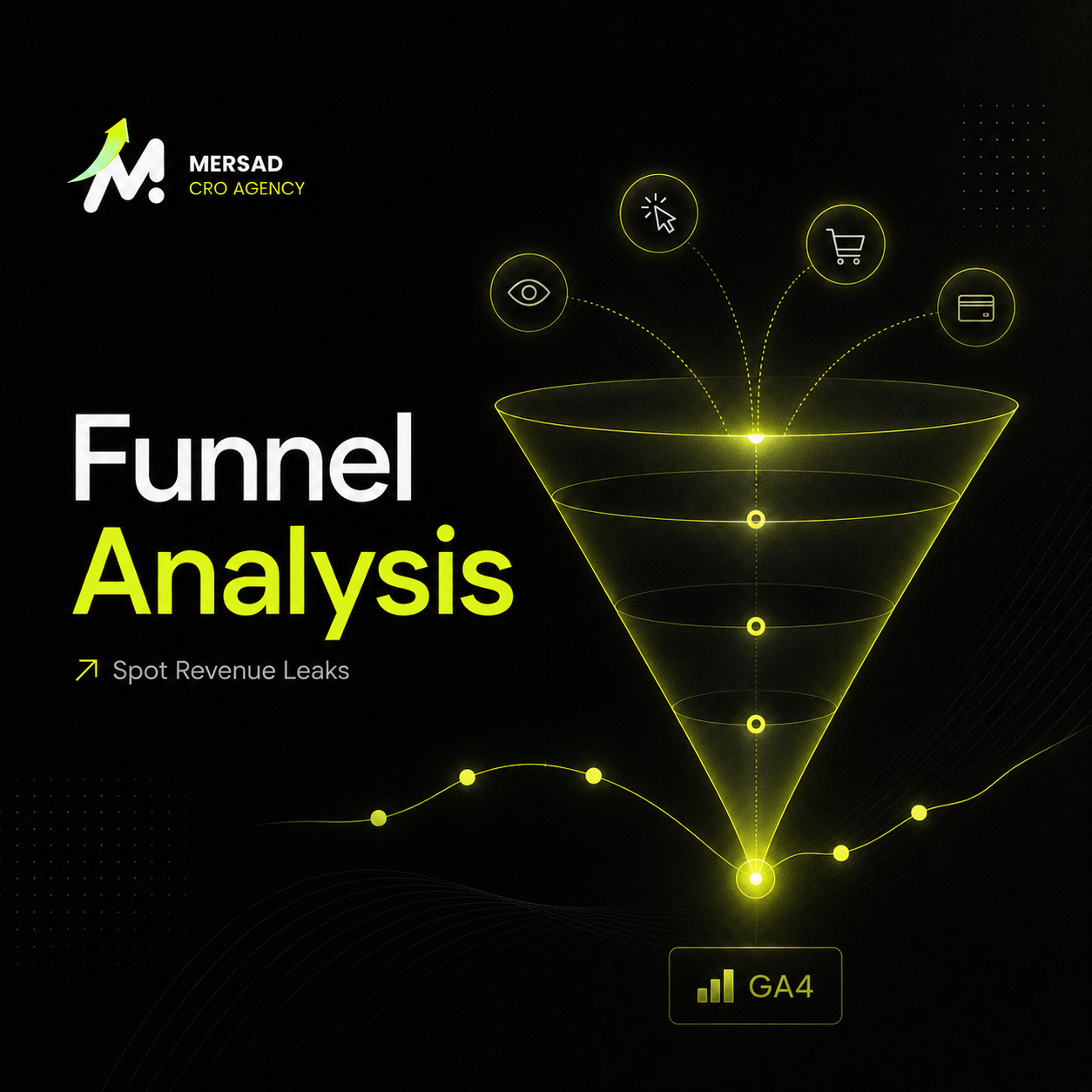
Ecommerce funnel analysis is the process of measuring how users progress through the shopping journey and identifying where intent is lost. GA4 Funnel Exploration can visualize defined steps and show how users succeed or fail at each stage.
The objective is not simply to find the largest drop-off percentage. The objective is to identify the highest-value revenue leak, understand which segments contribute to it, and determine whether the cause is traffic, UX, technical performance, product mix, tracking, or operations.
Build the Funnel on Reliable Events
A standard ecommerce funnel may include view_item, add_to_cart, begin_checkout, add_shipping_info, add_payment_info, and purchase. The exact structure should match the platform and customer journey.
- Validate event names and parameters.
- Confirm item and revenue values.
- Compare GA4 purchase data with the store backend.
- Check duplicate events.
- Document optional and required steps.
- Separate payment attempts from successful purchases.
Open vs Closed Funnels
An open funnel allows users to enter at any step. A closed funnel requires users to start at the first defined step. Use the model that matches the question.
A closed Product View to Purchase funnel helps evaluate the complete buying journey. An open checkout funnel may be more useful when some customers enter checkout from saved carts or direct links.
The Core Funnel Questions
- What changed?
- Where did the decline or uplift begin?
- Which segments contributed most?
- Is the issue traffic, conversion, product mix, tracking, or operations?
- What are the likely explanations?
- What validation is required?
- What is the next action?
Segment Before Concluding
- Device
- Source/Medium
- Campaign
- New vs Returning
- Geography
- Landing Page
- Product Category
- Browser
- Payment Method
- Delivery Region
If mobile Checkout Completion falls while desktop remains stable, the blended rate may hide the problem. If Paid Social traffic grows sharply, the overall Conversion Rate may fall even when site efficiency is unchanged.
How to Identify the Most Valuable Leak
Do not rank opportunities by percentage drop alone. Estimate the number of users lost, their purchase intent, expected order value, and the feasibility of improvement.
A 10% loss from 20,000 checkout users can be more valuable than a 50% loss from 500 product viewers.
Common Funnel Patterns
High Product Views, Low Add to Cart
- Weak product relevance
- Poor Product Page content
- Price resistance
- Variant confusion
- Stock limitations
- Low-quality traffic
High Add to Cart, Low Checkout Start
- Shipping surprise
- Coupon friction
- Cart errors
- Minimum order conditions
- Weak cart CTA
- Low purchase intent
High Checkout Start, Low Payment
- Form complexity
- Guest checkout issues
- Delivery uncertainty
- Missing payment methods
- Trust concerns
- Technical errors
High Payment Attempts, Low Purchase
- Payment failures
- 3DS issues
- Gateway errors
- Incorrect decline handling
- Tracking problems
Use GA4 With Supporting Evidence
The funnel shows where behavior changes. Session recordings, support tickets, surveys, reviews, and technical logs help explain why.
Revenue per Step
Add transaction value and product mix to the analysis. Two segments can have the same Purchase Rate but different Average Order Value or margin.
Avoid False Diagnoses
- Do not assume correlation is causation.
- Do not compare periods without checking campaign and product mix.
- Do not ignore stock and delivery changes.
- Do not trust a funnel built on broken events.
- Do not treat every step as equally important.
A Funnel Investigation Workflow
- Validate tracking.
- Define the funnel.
- Compare periods.
- Calculate absolute and percentage changes.
- Segment the change.
- Review landing pages and products.
- Use qualitative evidence.
- Estimate commercial impact.
- Prioritize actions.
- Measure after implementation.
Open-Funnel and Closed-Funnel Use Cases
Use a closed funnel when the analysis requires a defined starting point, such as users who viewed a Product Page before purchasing. Use an open funnel when customers may validly enter later, such as returning to Checkout from a saved cart.
How to Compare Two Periods
- Confirm that tracking definitions did not change.
- Compare traffic volume and mix.
- Calculate step conversion rates.
- Calculate the absolute number of users lost.
- Segment the largest changes.
- Review products, campaigns, and landing pages.
- Check stock, delivery, payment, and promotion changes.
High-Traffic Zero-Revenue Segments
Segments with meaningful traffic but no revenue deserve immediate validation. They may represent broken tracking, irrelevant traffic, technical failures, unavailable products, unsupported geographies, or landing-page mismatch.
Funnel Reporting Mistakes
- Mixing user and session scopes without explanation.
- Comparing funnels with different event definitions.
- Ignoring time between steps.
- Using one funnel for all product categories.
- Assuming the largest drop is the highest-value opportunity.
- Ignoring purchases completed through a different valid path.
Frequently Asked Questions
What is the best ecommerce funnel in GA4?
The best funnel matches the decision being investigated. A standard shopping funnel is useful, but category, campaign, Checkout, and repeat-purchase funnels may require different steps.
Should funnels use users or sessions?
Choose the scope that reflects the question and keep it consistent. User-level analysis is useful for journeys spanning sessions, while session-level analysis may be useful for campaign or landing-page efficiency.
Can a funnel prove why users leave?
No. Funnel data identifies where progression changes. Qualitative research and technical evidence are needed to investigate why.
Conclusion
GA4 funnel analysis is not a screenshot of drop-off rates. It is a structured investigation that connects customer progression, segment behavior, product mix, and revenue impact.
Mersad helps ecommerce teams build reliable funnels, diagnose revenue leaks, and translate findings into prioritized CRO actions.